We asked 70 People, Seven Questions
About Race & Ethnicity in American Culture
This is What they Said!
Presentation Handout
Presentation Handout
Posted in Presentations, Student Post | Tagged Binu Jacob, Chris Mauro, Honors Studies, Jasmin Nieves, Joe Eulo, UCC | 1 Comment »
The Construction of Race and Racism
Defining Ethnicity & Nationality
First let me start by defining Ethnicity and Nationality which are terms that are often confused with race. Ethnicity refers to particular groups of people that share some common heritage, traditions, or language. Before the world was made up of distinct nations, states or countries, certain pieces of land were connected to ethnic groups. Some examples are:
• Anglos and Saxons – England
• Mayan – Southern Mexico/Central America
• Greeks – Greece
• Pueblo– New Mexico
Since some countries were made up mostly of one ethnic group, people began to believe that nationality and the country which a person is a citizen of was the same as ethnicity. For example, a person from Denmark is Danish. But more often the name of the country doesn’t refer to the ethnic origins of its citizens. A person from Spain would be thought of as Spanish, although their ethnicity could be Gitano. Many countries like Spain are actually made up of various ethnic groups. The United States is a perfect example. Many people like to make ethnic distinctions as well as national distinctions to hold on to their ethnic culture and identity. For example:
• Italian-American – Ethnicity is Italian and nationality is US American
• Chinese-American – Ethnicity is Chinese and nationality is US American
Of course, ethnicity becomes more confusing in the process of immigration. As an example, we know in the case of China there are many ethnicities and that diversity gets lost often in how people identify their ethnic identity to non-Chinese people here in the U.S. So although a Chinese-American’s specific ethnicity may be Han, Manchu, Yi or another of the over 50 ethnicities in China, here in the United States those differences get simplified as being Chinese.
What is Race?
Race is a false classification of people that is not based on any real or accurate biological or scientific finding. In other words, the distinction we make between races has nothing to do with scientific fact. Race is a political construction. It is created by people for a political purpose. The concept of race was created as a classification of human beings with the purpose of giving power to white people and to legitimize the control of white people over non-white people.
Religion as a justification for racism
During the reformation of the 16th Century and 17th Century, a key question among Christian religious chain of command was whether Blacks and Indians had souls and/or were human. In this time period, Europeans were exposed more frequently to Africans and the native people of North and South America, and the church struggled between opinions. The Catholic and the Protestant churches arrived at different answers to the question at different times, which created significant differences between the two systems of slavery. The Catholic Church was the first to admit Blacks and Indians had souls, which meant in many Catholic colonies, it was against the law to kill a slave without reason. The Protestant Church wanted to separate and distinguish themselves from Catholics, and therefore was much slower in recognizing the humanity of Africans and Indians. With the increasing importance of slavery, religion was used as a means to justify racism, classifying people of color as soulless. However, as substantial numbers of people of color converted to Christianity, and as religion itself lost much of its power as a legitimizing agent, justifications for the cruelty against slaves changed. The slave-based economy in the south needed a racist manipulative system, which led to the development of various theories to explain human difference and to justify slavery.
Science as a justification for racism
During the 19th century, a scientist named Darwin published on the Origin of the Species in 1859, his book documented the process of evolution. Darwin believed in a natural order to the development of species; the weak die off and the strong survive. Although evolutionary theory is not racist, philosophers and social scientists used Darwin’s theory in scientific ways to justify racism. This way of thinking was later called “Social Darwinism” and had brutal consequences. In 1838 JC Prichard, a famous anthropologist, lectured on the “Extinction of Human Races” He stated that it was obvious that “the savage races” could not be saved. It was the law of nature. In 1864, W. Winwood Reade published his book called Savage Africa. He ended the book with a prediction on the future of the black race. According to him, England and France would rule Africa. Africans would dig the ditches and water the deserts. It will be hard work and the Africans will probably become extinct. It illustrated the convenient law of nature, that the weak must be devoured by the strong. It should be noted that there were many examples of this type of thinking. Prichard and Reade were all highly regarded thinkers. Around the world, native peoples in Africa, Asia and the Americas were dying and disappearing. The leading scholars didn’t think this was due to the unlawful abduction of land, which undermined their lives, culture and means of survival, while spreading disease and death. This theory was justified by the laws of nature, in other words, survival of the fittest. European and European American resettlement of native land throughout the world in this period created the consequence of extermination. This provided motivation for supposedly scientific research, which in turn provided exterminators with an alibi by declaring the extermination of the weak race.
The meaning of WHITE
The term white emerged as a classification of people during the 1700s in the British colonies of North America. Europeans were immigrating to the New World for many reasons, some seeking prosperity while many people were escaping discrimination, particularly religious and ethnic conflict. As Europeans arrived in America, groups such as Germans, Dutch, English, and French were encountering each other for the first time. In the colonies, the European settlers in power were under considerable stress, attempting to maintain control of their African Slaves and their white indentured servants, while trying to protect themselves from the alleged threat from Native Americans. At this time, poor white indentured servants were building alliances
and relationships with African slaves due to their similar state of repression. The term white was defined as anyone without a drop of African or Indian blood. The category white was created as a political construct that was used as an organizing tool to unite Europeans in order to consolidate strength, increasing their ability to maintain control and dominance over the Native Americans and African slaves, which in many places outnumbered Europeans. Whiteness is a constantly shifting boundary separating those who are entitled to have certain privileges from those whose abuse and exposure to violence is justified by their not being white. White is an artificial creation because the definition of white changes due to time and geography. Not everybody has been considered white at the same time. Irish, Jews, Italians for example went
through a process of becoming white. This was a process of assimilation that required certain cultural losses in order to gain white privilege and power. Some people, South Americans for example, who may have been considered white where they once lived were now considered Latinos by white society when they moved to the U.S. But just because race and whiteness were created, doesn’t mean that it doesn’t essentially affect our world.
The term People of Color
People of color’ is not a term that refers to a real biological or scientific distinction between people. People of color in the U.S. share the common experience of being targeted and demoralized by racism. Unfortunately, one of the ways racism operates is to keep people of color divided. Many people only think about their specific ethnic or racial group when discussing repression or the need to build political power. By using the term people of color, we begin to push people to think more broadly. We need to build relationships with other groups of color and overcome racism.
Posted in Student Post | 1 Comment »
I just wanted to share this site. Check out #27, #44, and #95.
http://www.americanrhetoric.com/top100speechesall.html
Posted in Student Post | Leave a Comment »
Posted in Presentations | Tagged Alecia Campbel's Plantains, Presention | Leave a Comment »
CHRIS: I think that it’s important to understand the different parts of the word inter racial – I don’t like Dictionary.com’s definition of race or racial. It’s a subjective point of view.
THERESA: In certain parts of the country schools are allowing students to choose more than one racial category on forms. For example, an interracial child can choose both categories. So it seems that they are furthering separating individuals.
Sue: I don’t think that further segregates you I think it opens up the options.
Theresa: Yeah but when we think about test scores how are they going to figure it all out?
JOE: Thinking about our interviews a lot of people said they choose not to be defined by race. I thought everyone would have different opinions.
THERESA: Would have the answers been the same if they were answered anonymously. I think they would have answered differently.
SUE: I think it’s interesting that many people have .7 friends of a different race.
MYRNA: Realistically I don’t think you can be of one race. Everyone is of some type of mixed race. I believe that the lives have been blended in together and there is no complete one person as one race.
CHRIS: I believe there is no genetic difference between any distinct race; another person came back with the concept of physical differences in features other than color.
BRIT: I think it was unbelievable when I saw my cousin who is black, her son is Korean and her other child is Chinese and her husband is white. I thought it was the most beautiful thing I ever saw.
QUESTION: WHY DO WE TEACH OUR CHILDREN THAT RACE IS NOT A TOPIC TO DISCUSS?
MYRNA: Most parents teach their children to be embarrassed about racial issues. Kids aren’t born racist.
QUESTION: WHAT IS THE INTERSECTION BETWEEN RACE AND CLASS (EITHER SOCIAL OR ECONOMIC) AS IT RELATES TO INTERRACIAL MARRIAGE? (REFER TO PAGE 22, LAST PARA.) IS THERE A SOCIAL COST BY MARRYING OUTSIDE OF ONE’S RACE? WHAT WOULD THAT BE AND WHY?
Sue: Regardless of economic class, even if you are the poorest white male/female, you are still considered socially higher than someone of another race.
SUE: Interracial marriage is a trade off.
SHERI: What about the interracial marriage between the white man and the Asian woman who is stereotypically docile, submissive and intelligent. We don’t normally think of Asians as lower class and Asians are attached to the good stereotypes; they are considered the model minority.
SUE: We also have to look at the population. (p.9)
SHERI: it’s almost more natural to see white and Asian together. They are equally classed.
CHRIS: It’s more equal. It’s a value. So even though Asian isn’t white, it’s more acceptable to be them than with Blacks.
RACHEL: The two (Asian and White) are seen as more equal.
QUESTION: HOW DO HISTORICAL EVENTS SUCH AS LEGISLATION AND WAR AFFECT THE TREND OF INTERRACIAL MARRIAGE?
WHY DOESN’T THE ESSAY DISCUSS INTERRACIAL MARRIAGES BETWEEN BLACKS AND SPANISH OR WHITE AND SPANISH? HOW WOULD FRYER’S ARGUMENT BE APPLIED TO THESE GROUPS?
SHERI: Marriage is a social contract. The trade off for some is just being married.
Sue: Interracial marriage disrupts the expectation of the social contract. The white community would think of white women marrying out of their race as a stepping down.
CHRIS: The value outweighs the cost for whites.
WRICE: The true cost is in your children. The primary goal is to prolong your legacy. If your legacy is less likely to look like you then you are not prolonging your legacy.
CHRIS: Looking at this economically, the social trade off is that beauty or intelligence can outweigh race.
WRICE: That’s what racism is: it’s when you project something negative on someone else to make you feel more comfortable about yourself.
THERESA: I agree with page 6. Mixed Race children have a choice in their behaviors. I believe that people will choose based on their environment.
SHERI: May feel as if they don’t belong to any group-as the article states.
CHRIS: If the parents of mixed race children decided to come together and “buck” the system, i.e. choosing a path that is not the norm or socially accepted, then wouldn’t the children of an interracial couple also have these same characteristics and “buck” the system? When you go with someone of another race, it is not something that is pleasurable when in social situations. People stare and there are certain stigmas that are placed on that relationship.
QUESTION: WHAT DOES IT MEAN TO “ACT BLACK” OR “ACT WHITE”? WHAT DOES IT MEAN TO “TALK BLACK” OR “TALK WHITE”?
CHRIS: If we go back to the mixed race child, consider that we talked about genomes and how these are characteristics that can show up in the offspring. Hence, if both parents take risks (step outside of the monoracial relationship) then the child will take risks.
MORE RISKS, MORE REWARDS-That’s Business 101. Fryer keeps bringing it back to opportunity costs.
SHERI: Something Fryer mentioned in the “Acting White” essay, I applied to the missed race essay. All the risks that they may take may be traditionally associated or stereotypically associated with acting black. So mixed race children may feel that need to buck the system and act black to show their blackness, especially if they are visually very fair in color.
CHRIS: Marginal, would probably mean “produces less than the amount
RACHEL’S QUESTION: IF RACISM IS LEARNED IN THE HOME ENVIRONMENT, CAN RACISM BE UNLEARNED?
Posted in Class Discussions | 1 Comment »
http://news.yahoo.com/s/ap/20090404/ap_on_re_us/one_man_s_apology
this article came up on Yahoo! news today. it’s about a man who was involved with the klu klux klan when he was younger. he is now apologizing for the things he did in his youth, including harming John Lewis, a Congressman from Atlanta. i found it interesting that so many years later he felt remorse for the things he did. and even though people are calling him a “hero” for these apologies, he says it doesn’t make him feel like one. so does this prove that people really can change their views on things like this? or is he just doing it to make himself feel better since he’s sick now or something?
Posted in Student Post | Leave a Comment »
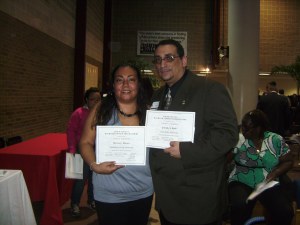 What a wonderful night! I was fortunate enough to spend it with my classmates, my friends, and my professors. I never saw so many beutiful people all in one place at the same time. I can only describe it as what heaven would be like. I was wowed when Myrna showed up looking glam, proud when Alicia’s name was called over the loudspeakers, and speechless when Jasmin sashayed to recieve her award. A great night, with great people, and great memories that will last a lifetime.
Posted in Outside Activity, Student Post | Tagged Honors Studies, UCC Foundation, Union County College | Leave a Comment »
http://www.huffingtonpost.com/2009/01/16/morgan-freeman-pays-for-i_n_158628.html
i forgot how to post a link on this, so i’m just copying & pasting the URL. In any case, I came across an article a magazine about how some parts of the country still hold segregated proms. My first reaction was that of utter disbelief. It turns out that they’re not held by the school, but they’re privately held proms. In any case there is the “white” prom and the “black” prom. There are students that have talked about uniting the students in order to hold a regular prom with all of the students, it falls apart because there is some resistance towards it. The article that I included is about a high school in Charleston, Mississippi that will be holding its first integrated prom this year. It is the hometown high school of Morgan Freeman, and he is funding the prom. Everything is being taped and turned into a documentary that will air in June. I just found it interesting that there are still parts of the United States where things like this happen. There are still schools with a segregated prom that were in the article I read, but it’s not online at this time. If it gets posted to the webpage, I’ll put the link up. What are your thoughts on the idea that there are still some schools that have segregated proms even though the student body is (at least superficially) integrated??
Posted in Student Post | Leave a Comment »
Posted in Student Post | Tagged Upscale store | Leave a Comment »
So a couple of days ago I was watching tv and im not going to lie, I was watching the Disney Channel because my favorite cartoon is the Proud Family!!! They had the best episode i have ever seen in my life!! It was about racism and the story goes as follows. Penny was in class and they were celebrating black history month. Her teacher, who is black, assigned them a project of researching a black person. Penny was assigned Angela Davis and during the night she had a dream tat sucks her back into time. She becomes Angela Davis and on her way to school she tries to talk to her friend Zoe, who is white, but she ignores her and Penny can’t understand why. Then her black friend D’Jane tells her they arent allowed to speak to each other. When they get to class all of the colored kids are in the back and the white kids are in the front. The teacher turns out to be the white janitor from the future and the janitor happens to be the black teacher from the future. Then and incident happens with Zoe’s bird and Penny’s mom happens to be a veterinarian and Penny takes Zoe and her bird to her house. When they get there Penny’s father says to her “You can’t be friends with her she’s white and you’re black!” To speed it up, when Zoe and Penny get back to class and they sit next to each other and the whole class stops and the teacher says they can’t sit next to each other! Then the students have a sit in so that they can sit next to each other and the teacher finally gives in.
It was an unbelievable episode it touched me so much because they didn’t sugar coat anything. The said things like they can’t be friends because their black and white. I mean it was incredible! They really taught children, who were watching the show, about what happened in the past and how everyone wasn’t equal. It was an episode that I would recommend all families watch because they kept it so real. The funny thing was I was at my best friends house and her little brother had a little white friend over and he was so wrapped up in the episode like we were he didn’t notice anything around him. The episode was so deep and refered to so many racial issues with respect to color that my best friend’s step father came running downstairs to see what we were watching! It was an excellent episode and everyone should see it unfortunatley i didn’t get the name of it but Im gonna try to find it!!!
Posted in Student Post | Tagged Disney, Proud Family | 1 Comment »
http://www.economics.harvard.edu/faculty/fryer/papers_fryer
Posted in Class Discussions | Leave a Comment »
Hi everyone!
just wanted to share a post with you guys, which I find incredibly interesting. Its a poem called “teacher teach us this” which was posted on You-Tube by a member of the Mexican Movement for Nican Tlaca Indigenous people. This poem is very insightful in terms of expressing the views and concerns of the Mexicans on border control by the Americans.
Posted in Student Post | Tagged immigration, mexicans, nican tlaca | Leave a Comment »
Posted in Student Post | Tagged Disney, first black princess | Leave a Comment »
I was logging on to aol this morning and I came across this article on aol’s black voices section about disney’s first black princess and how she doesn’t have a black prince and I thought it would be interesting to see what you all thought!!!
Posted in Student Post | Leave a Comment »
I did an informal writing on this article and Maxwell suggested that I post it for everyone to read. Please read and share your thoughts and comments. Enjoy! In case you want to see the site where the article is, here is the link: http://www.time.com/time/printout/0,8816,967892,00.html
What is culture, after all? The immigrant shrugs. Latin Americans initially come to the U.S. with only the things they need in mind — not abstractions like culture. They need dollars. They need food. Maybe they need to get out of the way of bullets. Most of us who concern ourselves with Hispanic-American culture, as painters, musicians, writers — or as sons and daughters — are the children of immigrants. We have grown up on this side of the border, in the land of Elvis Presley and Thomas Edison. Our lives are prescribed by the mall, by the 7-Eleven, by the Internal Revenue Service. Our imaginations vacillate between an Edenic Latin America, which nevertheless betrayed our parents, and the repellent plate-glass doors of a real American city, which has been good to us.
Hispanic-American culture stands where the past meets the future. The cultural meeting represents not just a Hispanic milestone, not simply a celebration at the crossroads. America transforms into pleasure what it cannot avoid. Hispanic-American culture of the sort that is now in evidence (the teen movie, the rock song) may exist in an hourglass, may in fact be irrelevant. The U.S. Border Patrol works through the night to arrest the flow of illegal immigrants over the border, even as Americans stand patiently in line for La Bamba. While Americans vote to declare, once and for all, that English shall be the official language of the U.S., Madonna starts recording in Spanish.
Before a national TV audience, Rita Moreno tells Geraldo Rivera that her dream as an actress is to play a character rather like herself: “I speak English perfectly well . . . I’m not dying from poverty . . . I want to play that kind of Hispanic woman, which is to say, an American citizen.” This is an actress talking; these are show-biz pieties. But Moreno expresses as well a general Hispanic-American predicament. Hispanics want to belong to America without betraying the past. Yet we fear losing ground in any negotiation with America. Our fear, most of all, is of losing our culture.
We come from an expansive, an intimate, culture that has long been judged second-rate by the U.S. Out of pride as much as affection, we are reluctant to give up our past. Our notoriety in the U.S. has been our resistance to assimilation. The guarded symbol of Hispanic-American culture has been the tongue of flame: Spanish. But the remarkable legacy Hispanics carry from Latin America is not language — an inflatable skin — but breath itself, capacity of soul, an inclination to live. The genius of Latin America is the habit of | synthesis. We assimilate.
What Latin America knows is that people create one another when they meet. In the music of Latin America you will hear the litany of bloodlines: the African drum, the German accordion, the cry from the minaret. The U.S. stands as the opposing New World experiment. In North America the Indian and the European stood separate. Whereas Latin America was formed by a Catholic dream of one world, of meltdown conversion, the U.S. was shaped by Protestant individualism. America has believed its national strength derives from separateness, from diversity. The glamour of the U.S. is the Easter promise: you can be born again in your lifetime. You can separate yourself from your past. You can get a divorce, lose weight, touch up your roots.
Immigrants still come for that promise, but the U.S. has wavered in its faith. America is no longer sure that economic strength derives from individualism. And America is no longer sure that there is space enough, sky enough, to sustain the cabin on the prairie. Now, as we near the end of the American Century, two alternative cultures beckon the American imagination: the Asian and the Latin American. Both are highly communal cultures, in contrast to the literalness of American culture. Americans devour what they might otherwise fear to become. Sushi will make them lean, subtle corporate warriors. Combination Plate No. 3, smothered in mestizo gravy, will burn a hole in their hearts.
Latin America offers passion. Latin America has a life — big clouds, unambiguous themes, tragedy, epic — that the U.S., for all its quality of life, yearns to have. Latin America offers an undistressed leisure, a crowded kitchen table, even a full sorrow. Such is the urgency of America’s need that it reaches right past a fledgling, homegrown Hispanic-American culture for the darker bottle of Mexican beer, for the denser novel of a Latin American master.
For a long time, Hispanics in the U.S. felt hostility. Perhaps because we were preoccupied by nostalgia, we withheld our Latin American gift. We denied the value of assimilation. But as our presence is judged less foreign in America, we will produce a more generous art, less timid, less parochial. Hispanic Americans do not have a pure Latin American art to offer. Expect bastard themes. Expect winking ironies, comic conclusions. For Hispanics live on this side of the border, where Kraft manufactures Mexican-style Velveeta, and where Jack in the Box serves Fajita Pita. Expect marriage. We will change America even as we will be changed. We will disappear with you into a new miscegenation.
Along and across the border there remain real conflicts, real fears. But the ancient tear separating Europe from itself — the Catholic Mediterranean from the Protestant north — may yet heal itself in the New World. For generations, Latin America has been the place, the bed, of a confluence of so many races and cultures that Protestant North America shuddered to imagine it.
The time has come to imagine it.
Posted in Student Post | Leave a Comment »
Yesterday, while I was flipping through the channels and I came across the Tyra Banks Show. Her topic was “Myths of Racial Perceptions” and I immediately thought of our class. Unfortunately, I only saw the second half of the show, but I did not miss some of the most ignorant and racist comments that I have ever heard. A diverse group of people were chosen to watch case studies together and comment on them. (The link below includes a clip of these case studies). One such case study included two identical scenes where there was a white woman with three children and a black woman with three children. The participants agreed that the white woman probably had a stable income and a supportive husband with a good job. However, two white participants said that the black woman was on welfare because she was too lazy to work. Later Tyra asked one of the white participants why he felt the way he did and his response was that in his town (somewhere in Texas), every black woman he encountered was on welfare and had different fathers for each of their children. Basically, he was putting the blame on his surroundings and media. Tyra called him out on his ignorance and told him she was tired of that excuse. She couldn’t understand how he was in college and yet still believed what he did, especially when the internet, one of the biggest forms of media, was available to him. Another scenario depicted a Latina and a white woman talking and the participants were asked which person was the boss. Everyone agreed the white woman was the boss and when asked if both women had the same education level, a white participant said no claiming that in her high school, the Latina girls did not do well in their classes. She also said that these Latina girls had poor hygiene; her exact statement was: “they came to school stinking.”
Although many of the statements said during this segment were appaling and disgusting, I was not at all surprised. Racism is very much alive and I’m glad that Tyra did this show and created a dialogue. My hope is that this dialogue continues and the newer generations of our country can move forward in the direction of positivity and acceptance.
http://tyrashow.warnerbros.com/2009/03/racial_perceptions.php
Posted in Student Post | Tagged myths, Race, tyra banks | Leave a Comment »
I read an article this morning regarding a topic we discussed in class. Schools in certain parts of the country will begin incorporating additional categories that students can check off involing his or her race or ethnicity. I am torn about this decision. Part of me believes that a student will be able to acknowledge both races or ethnicities when the change goes into effect. Enabling a student and the parents not to be forced to choose one or the other. At the same time, instead of uniting races and eliminating the division of students based upon skin color or ethnicity, we are in effect further dividing students and teaching them at a young age that there is a division between people. I found the article very interesting. Hope you do too.
Posted in Student Post | Tagged race choices, Schools | 1 Comment »
Hey Everyone. Hope you all are enjoying your spring break!
I just saw this show called “What would you do?” on ABC. The purpose of the show is to play out certain fake scenarios to see how people in our society would respond.
Tonight, they had three white kids “beating up” a Latino man while calling the man “spic” and telling him to speak English. The supposed beating took place in front of a busy bar in Newark, NJ. While this beating occurred, about 67 people walking by this incident did nothing! When these people were asked for their reasoning as to why they didn’t try to stop the beating, they all just said that they didn’t want to intervene because they were afraid to get beaten on. A few other people who saw this incident either called 911 and shouted for the white kids to stop the beating- but of course, the scenario still keeps on being played out and the white kids didn’t listen.
There was ONE man, however, a Black man, who approached the white kids and was ready to put up a fight for them to stop until he was told by the show’s host that it was just a fake scenario. This was man said that he wanted to help because he knew what it felt like to be attacked and not helped by others. In another instance, one Hispanic woman also approached the kids and tried to push them off the victim- when she was told that it was all fake, she was relieved but said that she intervened because she hates when people of her own kind get picked on just for their ethnicity.
The purpose of this scenario was to see how people, of ALL ethnicities, would respond. Now- was it simply fear that held these people back from helping the Latino man or was it because people deny that racist and hate crimes exist as often as before?
I just imagine- what if the scenario included three Hispanic kids beating up a white man? I think that MORE people would’ve helped the victim out. What do you guys think? And better yet, What would you have done?
Posted in Student Post | 3 Comments »
Lanugage really is as important as some people make it out to be–it reflects a culture, its beliefs, and its values. It’s a way of thinking that shapes your view of the world. Some things cannot be translated from one langauge to another for this very reason.
As someone who has learned Spanish as a second language (I still need practice speaking it so I can’t really consider myself bilingual yet), I have had a new perspective about langugage, culture, and the way the both influence the way you think.
In English, we have one verb to express a state of being, “I am…” In Spanish, two verbs exist to express “to be.” “Estar” is used for temporary states of being, while “ser” is used for permanent characteristics. If someone asks me how I am in Spanish, I reply using the verb estar, so I know it is a temporary state. But if someone asks me how I am in English and I’m in a bad mood and I say “I am depressed” or “I am stressed,” there’s no distinguishing between a temporary mood and a permanent state.
In Spanish, it is also said that one “has hunger” or “has thirst,” but in English, we say “I am thirsty and I am hungry.” This, like the example of states of being, show that in the Spanish language, it is realized that emotions and states of being are temporary. Who you are is not what you are feeling at that exact moment. But in English everything is “I am,” or “my” and we hold onto everything.
In English, we “spend” time. In Spanish, you “pass time” In English, we “waste” time. In Spanish, you “lose time.” If I thought only in Spanish, maybe I would have a different perspective about time and I would stress out so much about “spending” or “wasting” time as if it were money and time were something I owned and it costs me.
Breaking or losing things have always been two things that stressed me out. In Spanish, you can say “se me rompio” or “se me perdio” or “se me olvido” which all roughly translate to “it broke/lost/forgot itself to me,” essentially meaning:it’s not my fault. it was an accident. I’m not to blame. Again, some things do not translate well. The concept doesn’t exist in English.
How beautiful is that? Instead of thinking, “I lost my keys,” I could think, “se me perdieron,” they are lost to me. Not as big of a deal because it’s not focused on “I” and then I don’t feel guilty and pissed off at myself.
There are so many more examples, but I don’t want to make this too long. Here’s one last one: In Spanish, there are different conjugation of a verb used depending on whom you are addressing. The forms are called tu and usted, or familar and formal. When you address a friend, you would ask “Como estas,” but when you are talking to adult, or someone older, or someone you don’t know or you respect, you would use the formal conjugation and ask “Como esta?”
That also doesn’t exist in English. They say kids don’t respect their elders anymore. But what if, in the English language, we had to address our elders in a different way? We would be more inclined to respect them and respect our family and, in general, be respectful.
Of course, this is all in theory and a bit idealistic, but the Spanish language at least provides the basis for it. And of course I’ve met hispanics who are not respectful at all(they were raised here though)….but you see where the theory is…
So where am I going with all this? I can understand why some people hold onto their languages and want to pass them down…maybe some people resist speaking english, even if they understand or know it, because they want to hold onto their culture….and maybe it’d be good for Americans to learn other languages and ways of thinking
Posted in Student Post | 1 Comment »
I really enjoyed this article – we take so much for granted. This is a reminder to ask questions of your parents and grandparents – the answers and stories may well surprise you!
Posted in Student Post | 1 Comment »
Washington Education Study Shows Sharp Rise in Latino Federal Convicts Sign In to E-Mail Print Reprints ShareClose LinkedinDiggFacebookMixxMy SpaceYahoo! BuzzPermalinkBy SOLOMON MOORE Published: February 18, 2009 Latino convicts now represent the largest ethnic population in the federal prison system, accounting for 40 percent of those convicted of federal crimes, according to a study released Wednesday by the Pew Research Center, a nonpartisan research organization. Skip to next paragraph Multimedia Graphic More Hispanics Sentenced Latinos made up only 13 percent of the United States adult population in 2007, but they accounted for one third of federal prison inmates that year, a result the study attributed to the sharp rise in illegal immigration and tougher enforcement of immigration laws. Nearly half of Latino offenders, or about 48 percent, were convicted of immigration crimes, while drug offenses were the second-most-prevalent charge, according to the report. As the annual number of federal offenders more than doubled from 1991 to 2007, the number of Latino offenders sentenced in a given year nearly quadrupled, to 29,281 from 7,924. Of Latino federal offenders, 72 percent are not United States citizens and most were sentenced in courts from one of the four states that border Mexico. Federal prisoners who are illegal immigrants are usually deported to their home countries after serving their sentences. “The immigration system has essentially become criminalized at a huge cost to the criminal justice system, to courts, to judges, to prisons and prosecutors,” said Lucas Guttentag, a lawyer for the American Civil Liberties Union. “And the government has diverted the resources of the criminal justice system from violent crimes, financial skullduggery and other areas that have been the traditional area of the Justice Department.” Last month, The New York Times reported that federal immigration prosecutions had increased over the last five years, doubling in the last fiscal year to more than 70,000 cases. Meanwhile, other categories of federal prosecutions, including gun trafficking, public corruption, organized crime and white-collar crime, declined over the same period. The federal justice system accounts for 200,000, or 8.6 percent, of the 2.3 million inmates in federal and state prisons and city and county jails. Nineteen percent of state prisoners and 16 percent of jail inmates were Latinos, the Pew study found. African-Americans, who make up about 12 percent of the national population, make up 39 percent of state prisoners and jail inmates. Deborah Williams, an assistant federal defender in Phoenix, said that the large number of Latinos in the federal system, particularly those who are not citizens and have limited English proficiency, had sharply changed federal prison culture. “I have Anglo and Native American clients who tell me about being the only non-Spanish speaker in their pod,” Ms. Williams said. “Ten years ago, it just wasn’t that way. Everything is changing in there, including the language, the television shows they watch, and a lot of times the guards don’t speak the language. How do you safely guard people who may not understand your orders?” A spokeswoman for the federal Bureau of Prisons, Tracy Billingsley, declined immediate comment on the Pew report. Mark Hugo Lopez, a co-author of the study, which relied on United States Sentencing Commission statistics, said, “It’s hard to understand whether we’re seeing a policy change or just a growth in the total number of immigrants coming to this country.” The number of illegal immigrants in the country increased to 11.9 million last year, from 3.9 million in 1992. Under federal programs like Operation Gatekeeper, which hired thousands of immigration enforcement officials along the Mexican border, and Operation Streamline, which instituted a “zero tolerance policy” for illegal border crossings in the same region, immigration crimes have skyrocketed. The large number of immigration crimes and low-level drug offenses account for the relatively light sentences that Latinos typically receive — about 46 months, compared with 62 months for white inmates and 91 months for African-American prisoners, according to the study. The hearing for José Sánchez on Wednesday in Los Angeles was typical. Having been convicted of illegal re-entry, Mr. Sánchez, 37, who has prior convictions for assault and drug possession, pleaded guilty in exchange for a sentence of 46 months. The hearing took less than 10 minutes. Mr. Sánchez, who has a wife and three children in the area, asked to be assigned to a prison nearby. He is likely to be deported to Mexico after serving his sentence. Rebecca Cathcart contributed reporting.
I’d love to hear opinons on the above article………
Posted in Student Post | 1 Comment »
http://www.state.nj.us/nj/home/features/spot_black_history.html
This is a brief but informative article honoring Robeson, Still and several other prominent African Americans. I hope you find it interesting too.
Posted in Student Post | Leave a Comment »


Hey Guys,
Here are two pictures that were posted online during the Election. They are comparing President Obama as Curious Geroge in both pictures. I want to know what your guys response is towards these pictures.
Posted in Student Post | Tagged curious geroge, election, obama, pictures | Leave a Comment »
I believe that Obama has been able to unify America in that he is a remarkable person with a lot of charisma, and people are able to relate to him. He is very smart and well spoken. He is focused on humanity and not race or financial brackets.
Throughout his whole campaign and even now, his theme was to make America better for all of us. Not just for African American but for everyone that lives in this country. Obama is different from all the other leaders as the leaders before him campaigns’, were more gear towards making it better for a particular race. Martin Luther king’s campaigns’ was for freedom for African Americans. He was also, in a time when there was so much segregation and the whites were not ready to embrace this change.
However, now is a time when the world is embracing change. Obama came at a time when America was willing to accept unity, and accept everyone. They were tired of all the negativity and have been yearning for a change; they were tired of all the sadness, and despair in America and they needed something or someone who fills them with true love, joy hope, and faith. He has reassured all Americans that that anything is possible if you believe and work hard.
Also through his speeches and life stories, he has been able to inspire a lot of young people, which other presidents were not able to do. Most young people are now able to really believe that they can be whoever they want to be. Moreover, they now know that there should be no excuse in why they cannot be their best.
Posted in Student Post | Leave a Comment »
| M | T | W | T | F | S | S |
|---|---|---|---|---|---|---|
| 1 | 2 | 3 | 4 | |||
| 5 | 6 | 7 | 8 | 9 | 10 | 11 |
| 12 | 13 | 14 | 15 | 16 | 17 | 18 |
| 19 | 20 | 21 | 22 | 23 | 24 | 25 |
| 26 | 27 | 28 | 29 | 30 | 31 | |
 | Nancy on Racism in Disney movies… |
 | susangk on 7 Questions About “Race… |
| susangk on The Construction of Race and… |
 | josepheulo on Class Discussion 4/2/09 |
 | rachelprib on Disney’s Proud Family, |


You must be logged in to post a comment.